
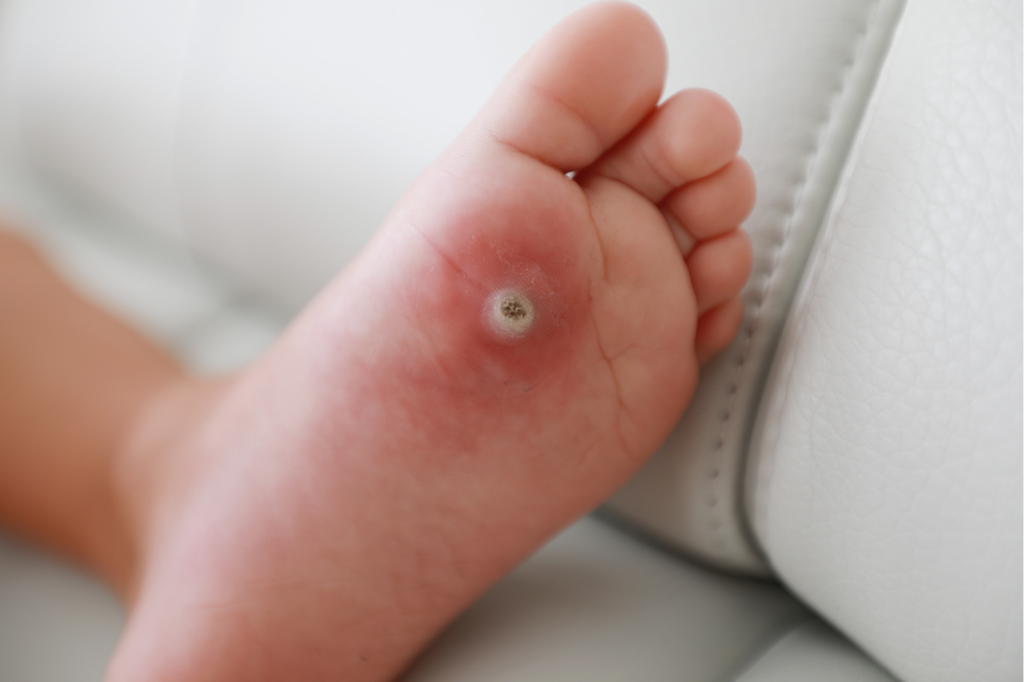
Warts are viral infections of the skin that cause growths. They can occur in various body parts and on different foot parts. In medical terms, the bottom surface of the foot, commonly known as the sole, is called the plantar surface. Warts found on the bottom of the foot are called plantar (not “planter’s”!) warts—simply describing their location.
How Plantar Warts Develop
The virus that causes warts cannot reproduce itself and cannot survive outside of a host. It invades the
skin cells of someone susceptible to the virus, takes over the reproductive mechanism of the cells and starts reproducing itself. If you see little black dots, they are your own blood vessels that the virus stimulates to grow along with it to keep it supplied with food and oxygen.
Understanding the Anatomy of a Wart
There are no “roots” to the wart, and it does not penetrate the skin. It needs your skin cells to reproduce itself, so there is always normal skin beneath the wart. The difference between a plantar wart and other warts is that you are weight-bearing on the wart as it grows, so it can’t grow out. As you walk on it, you press the wart and your skin down. Pain is associated with the bulk of the wart and the callus covering it. What you see on the surface of the skin in a plantar wart is like the tip of the iceberg.
Symptoms to Look For:
- Warts typically appear as round or oval growths on the skin with a rough surface.
- Warts may have tiny black dots, which are small blood vessels that have grown into the wart.
- Warts might not cause pain or discomfort unless located where there is repeated pressure or friction.
Treatment Options
Traditional treatments are designed to destroy the infected skin – acids burn the wart, and freezing causes the water in the cells to expand and burst the cells.
At The Foot Advantage, we use various strength acids and a novel treatment – The Swift Microwave Generator – that stimulates your immune system to fight against the virus causing the wart. Your Chiropodist can help you decide which treatment best suits your needs, schedule, and budget.